Chris Jarling

Electrical Toothbrush

I bought my first electrical toothbrush today. I think I also had one for some time when I was a child, but it’s the first one I bought in my adult life. I’m not sure why it took me so long to buy one. I’ve been thinking about buying one for years but never did it.

It makes so much sense though. I don’t like brushing my teeth. I also don’t hate it, but it’s a chore I have to talk myself into doing a lot of times. Today, I already brushed my teeth twice and am looking forward to doing it again when I go to bed. This might wear off, since this is new for me.

The toothbrush cleans my teeth much better then my old, manual one. Almost feels as good as when I get a professional cleaning at the dentist.

These two things are very much worth the (reasonable) price I paid for it.

I should have known better, though. Buying things that make chores fun has almost always been a good idea for me. I bought a vacuum robot (which did not make the chore fun but more or less made it disappear) and a vacuum for our windows, which now leads me to clean our windows a lot more often (though not that much in total – the point stands, though. Two times a year is twice as much as never). I’d also mention a dishwasher here, but this one feels a little different for me, as I still don’t enjoy the process of loading and unloading it. It just makes me hate the chore a little less.

Wonder what else there is that falls into that category. I think having a Tesla would probably make everything that is a chore and related to a car much more fun. That’s not really matching the points above, though, as a Tesla costs a little more than my electric toothbrush.

Read more →

Unpublished Writing

I do write a lot recently, but not much of it gets published on this website. What I publish is still a lot compared to the beginning of the year, yet it’s only a fraction of what I produce.
Some of it is just too private to show around the internet, even with my new endeavour to write more about personal things, emotions and be more vulnerable. But even that is the minority of my writing. For the most part, I just start writing things down and then abandon them.

I’m thinking about if this writing even is writing. If nobody reads it, does it really exist? It surely gives me something. Especially with the very personal things, writing them out creates a lot of headspace and clarity. But for the rest? I get to practice writing a little, but without even the possibility of feedback from the world, what is it even worth?
It feels like cheating. Writing isn’t easy, but for me the hardest part is not the act of writing, but putting it out in the world. While it’s just lying around on my computer, I’m comfortable. It cannot be labelled bad because no one in the world is able to read it. But it also cannot be good for the same reason. And if it’s neither good nor bad, is it anything at all?

Up until now, I thought that I wrote a lot. But my metric was off. I can only count what I published, and judging from that, I did not write that much.

Time to get more comfortable with putting stuff out in the world. Also time to get comfortable putting half-baked thoughts out there that I will be embarrassed of in 3 months or be corrected on after a few hours. Time to work with the garage door open.

Read more →

Recurring thoughts

My head and I, we have a complicated relationship.

Sometimes, good things come out of it. It can produce decent code, decent enough at least that someone is willing to pay me enough money for it so I can make a living out of it. Sometimes texts and ideas come out of it that I like. Those are the times where we walk hand and hand an have a great time.
Other times, though, it feels like the dickhead wants to fuck me over. Those are the times when I’m trapped inside it, pondering over things, questioning everything. In these times, it feels like my head is my enemy.

I have a lot of thoughts over the course of the day. Everything I do is accompanied by a thought. This might be what is called “inner monologue”. People that also have it might be able to relate.
In case you don’t have it: If you watched the show “Scrubs”, it’s a lot like J.D. narrating everything that happens.
This inner monologue is not a problem per se. But it becomes one once it goes into repeat.

Having it go on repeat is exhausting. Often times, it leads to pondering over things, which is even more exhausting. It causes me not to be in the present, but either in the (or a theoretical) future or the past. Those are not good places to spend the majority of your thoughts on. Ultimately, it tends to drag me down.
So, there’s a new rule in my life: No recurring thoughts allowed.

That’s easy to say, but how do I make them go away? It sounds a lot like telling someone not to think of a pink elephant or telling people suffering from depression to “just be happy and smile more”.
Luckily, I found a rather simple solution for my problem: Writing the thoughts down. This works for a couple of reasons:
First, I don’t have to keep the thought in my head anymore because I know it’s written down somewhere and won’t get lost. If I can’t remember it later on, I know I have written it down in one of the places I write things down. It’s safe to let it go now.
Second, building more complex chains of thought is easier if some parts of it are written down and I don’t have to keep the whole thing in my head. Exploring different solutions to a problem is easier as well, as I can write one solution down and don’t have to keep it in my head, allowing me to fully focus on the next.

The length of what I have to write down depends on the type of thought.
Simple “tasks”, things I must not forget to do, just require a bullet point in my notebook. They’re the easiest to deal with.
Ideas might require a few more bullet points so I can make sense of them later an, when I come back to them and lost the mental context. Sometimes, I also draw something.
And then there’s the heavy, deep stuff. That’s usually also the stuff that is hard to spot in the first place, as it gets pushed far back into my mind and suppressed by a lot of escape mechanisms. They usually require long form text, some time and pain.
Knowing exactly how much to write is hard beforehand. Luckily, the feeling when I did enough is pretty obvious. So I keep writing until it’s there.

I hope this look into my head made sense to you. Learning how other peoples’ brains work is one of the most interesting things to me. So let me know if you struggle with similar things or if it is completely different for you.

Read more →

Fatigue

It’s been over a month now since I tested positive for covid and almost 4 weeks since I tested negative. My energy levels are still not back to normal. They’re well under where they normally are: On a regular day without exercise, just doing my daily business (which comes down to 10-12km of walking), I am done at about 6 pm. I then feel like I felt after a really intense workout before covid, probably even worse. It has gotten to the point where I could barely stay awake a few times.

This text is not for me to complain about my situation. I know it could have hit me worse. Much, much worse. But this is the first time in my life that my body is hit hard by something and taking longer than a week or so to recover.
I guess the invincibility I seemed to have in my 20s is gone now. Likely a normal part of getting older. But it sucks nonetheless.
I’m not sure if what I experience qualifies as post-covid or long-covid, but given the research I did, it seems to be quite common. For the most people, it seems to last between 5 weeks and 4 months. I hope I’m on the shorter end of the timespan.

I’m uncertain on how to tackle this situation. Some people have had good experiences with just resting. Other people think that you have to rebuild your fitness from scratch and you have to take baby steps (and being exhausted is part of training).
Today was the first day in a week or so where I still have energy at 10 pm. I ate a lot today, probably 4000 calories (and most of them healthy). Not sure if this is the cause of having more energy or just a correlation. Or pure chance.

Again, I don’t want this text to be me complaining about my situation. I just wanted to have this written down for my future self somewhere. However long this goes on, I’m optimistic that I will cope with it and come out on the other end with some new learnings.

Read more →

Finding large folders in macOS

tl;dr: Use du -sh */ | sort -hr to find large folders or set the “calculate all sizes” option (it’s not as cool as doing stuff in your shell).

The other day, I wanted to upgrade macOS and was greeted by a dialog telling me that I did not have enough storage to install the update. Upon checking my storage, I realised that macOS hat about 120GB of my 256GB SSD allocated to “System Storage”.
The accepted solution to fixing this seems to be searching through Library folders until you find the beefy folders that take a lot of space (likely Docker or Xcode Emulators) and delete those you don’t need. Shouldn’t be too complicated.

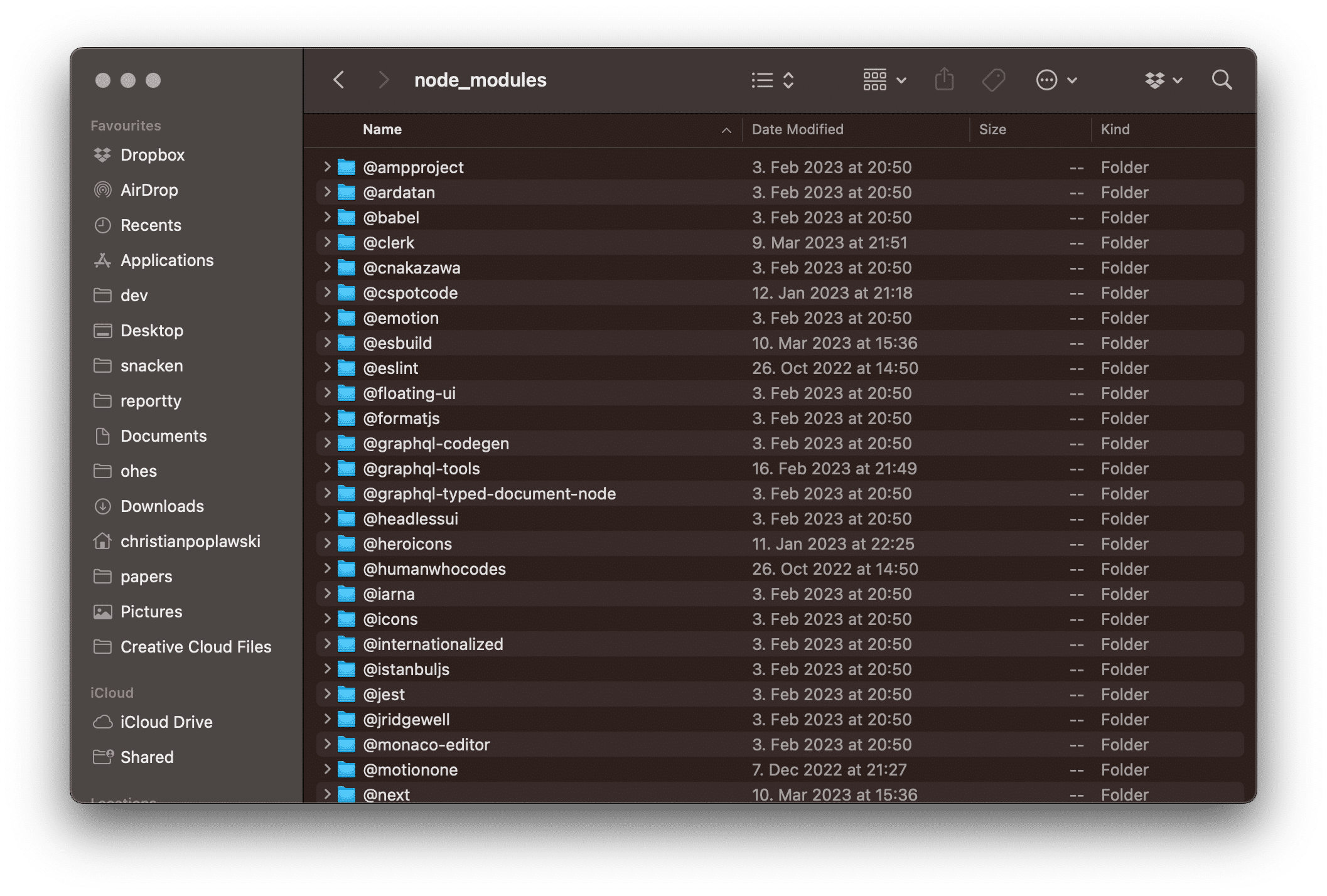
Enter Finder: Finder refuses to tell you how big folders are in its list view. You have to inspect the folder individually (either by choosing another view or by pressing cmd + s). That’s a somewhat tedious task to perform for a few hundred folders.

A finder window, not showing the size of folders

Luckily, macOS is built on unix and unix is great.
Unix comes with a program called du. du estimates disk usage of files and sounds like just the functionality we need. Running du -sh */ inside a folder will display a single entry per file (-s) and display the usage in a human readable way (-h).
We can use that output and pipe it to sort which… well, it sorts lines of text or binary files. Here, we want to use the -h flag as well so it can sort units like Megabyte and Gigabyte properly and also reverse the order (-r) so the larges files come first.

That leaves us with the final command du -sh */ | sort -hr.

~/Desktop
⟩ du -sh */ | sort -hr
78.2G	homework/
504K	do-not-touch/
428K	stuff/

Running this in all the Library folder macOS has will quickly lead us to the big folders.

Read more →

VS Code Search Editors

You probably know how to do project wide searches in VS Code: go to the magnifying glass in the sidebar or hit cmd + shift + f (you definitely want to use the keyboard shortcut for speed here) and search for whatever you need. VS Code will then go ahead and list all the places where what you searched for is referenced. Most of the time, this is enought. But it has its limitations.

Here’s a situation I find myself in some times: While working on something, I come across something I have not seen yet, let’s say a hook. Because I’m quite emerged in my work, I look at its name, get a vague feeling about what it might to and then want to look up all the places where it is used. I’ll probably need to look this information up quite often during my current task, so I just keep the search results open.
Some time passes by and I realise I’ll have to refactor a component. I better take a quick look if this is used in some places I did not expect.
Some more time passes. I need the references of the hook again. Damn, what was it called again?

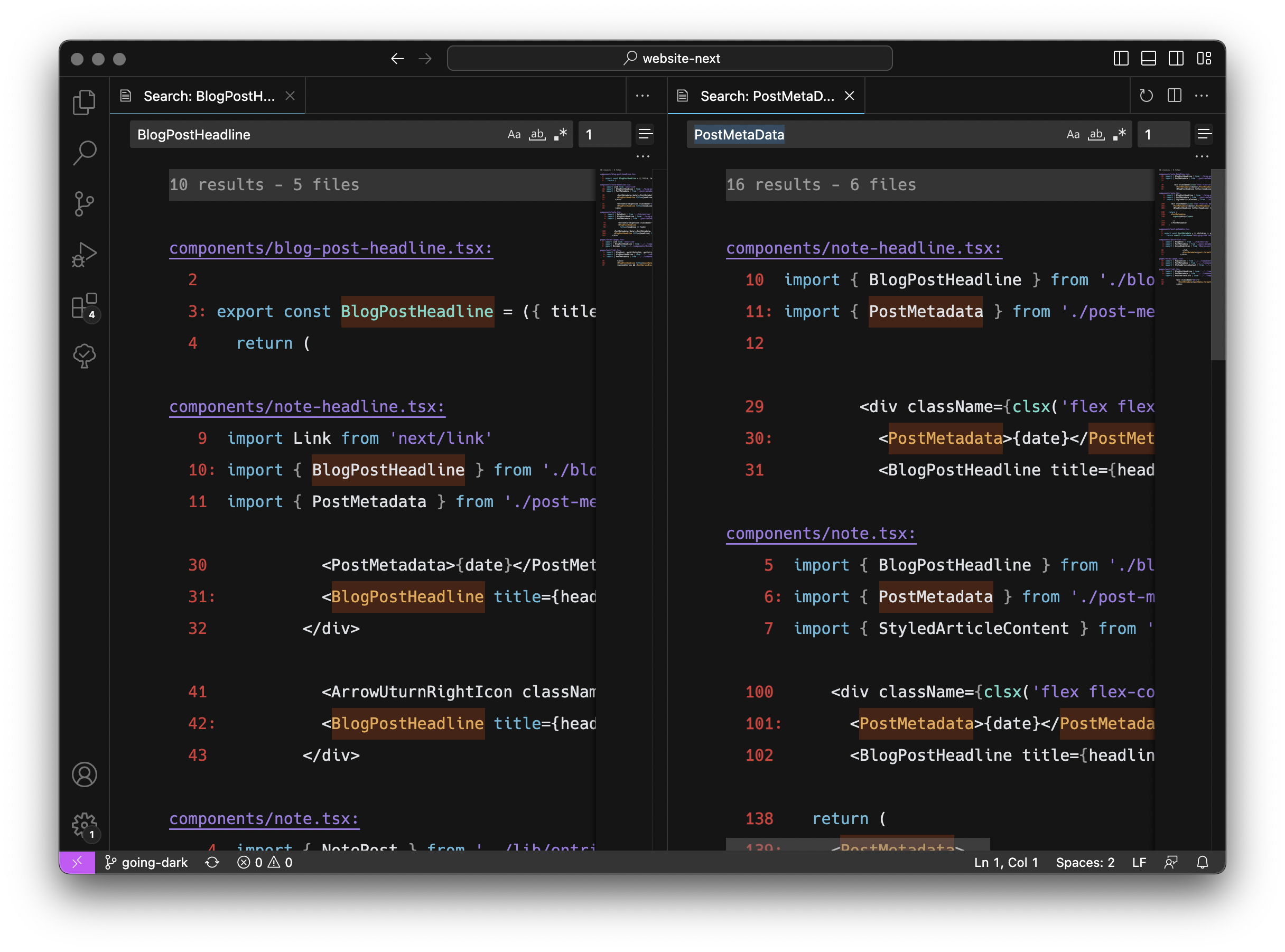
I recently learned about search editors in VS Code. They look a lot like what project wide searches look like in Sublime Text: They’re just an editor tab with all the search hits in them.

Search editors in VS Code

The fact that they are just regular editor tabs is what makes them great. You can have multiple tabs open. This means you can have multiple search editors open. Which solves my problem from above. You can just keep the first one open and then create a second one, allowing you to jump between them. They even show up in in the file search. You can also save them to the codebase if you really don’t want to lose them or want to share them with teammates.

There’s a number of ways you can open them:

  • From the command palette (cmd + shift + p) chose “New search editor”
  • Form the sidebar search, after having performed a search, click “open in editor”
  • Form the sidebar search, hit the open new search editor icon in the top row

There’s also some more info about them in the VS Code docs.

I don’t use search editors very often, but they do come in handy from time to time, so I’m really happy I found out about them.
Maybe I should read the VS Code docs more. Who knows what other useful features they built into this thing?

Read more →

Separating my Ideas from my Ego

This is something I’ve been actively working on for some time now. Today was the first time I noticed that I seem to have made a lot of progress in this regard. Here’s what’s happened:

We’re working on multiple apps. Both of them use msw to mock responses from the APIs we’re running against. One of them also has msw data set up, allowing for very configurable responses. The one uses static JSON-Fixtures as responses. I was working on the latter and hit a case where having msw data would have been really helpful.
It quickly became clear that we eventually wanted to use msw data in this app as well. So my thought was: I’ll just lay the groundwork and make it work for my current needs. After that, we can just gradually move the test suites over whenever someone is touching them. I communicated that idea. Timo had a different opinion. We went on and had a discussion with the whole team.

This discussion was great. A lot of arguments were presented (a lot of which I had not thought of at all) and no one took anything personal. Including me. This is kind of a big thing for me, because I identify with my work a lot (which is another problem). This also means that I often thought my ideas and opinions about things were linked to me personally. This, in turn, would mean that I saw criticism on my arguments and ideas as personal attacks.
Now, this was problematic, because I was no longer working towards a common goal (making the best product possible) but instead towards winning an argument for the sake of winning.

In the middle of the discussion, I realized that my initial argument was flawed, considered all the other input, and I moved away from it. In the end, we settled for a solution somewhere in the middle, that I’m quite happy with.
I’m a lot happier with the feeling the discussion left me with, though. I was able to see all facets of the problem and could help to work toward a solution that would be best for our common goal. This would not have been possible had I been personally offended all the time.

The next thing I need to work on is to stand my ground more when I’m sure my argument is objectively right. Not as easy for me as it sounds.

I recently read that all advice on the internet is wrong, and you should not give any. So I’m taking this advice and will not summarize this post in a sentence that tells you what to do. But keep your ego out of arguments.

Read more →

Grocery shopping with helicopters

I think it is safe to say that web development got a lot more complex since… I’m not sure. I haven’t been doing this for much longer than 10 years, so this is the only timespan I can judge. It definitely got a lot more complex since then. But I imagine this statement would also have been true 10 years ago. So my working theory is: web development got more complex ever since it started to be a thing. I asked ChatGPT and it agrees.

This rise in complexity has advantages and disadvantages.

It is a lot harder to get started in web development today. At least if you want to build something with state-of-the-art complexity. This is in the nature of the thing, of course. More complex things are harder to build. Now the entry itself is still the same. You would still start learning HTML, CSS, and then some JavaScript. But the road got a lot longer. There’s a lot more to learn after that: frameworks, tooling, multiple different devices to be supported, security, and performance to think about. All these things also change rapidly.

There is some amount of effort put into working around that, especially regarding configuration. I probably would have a hard time writing a webpack config from scratch today. I could figure it out because I used to write them in the past, but I can’t do it from the top of my head. I have not done it in several years. Simply because I did not have to. Tools like create-react-app abstracted that complexity away from me. I run a command and I have a configured app that I can tweak if needed.
I think it’s a good thing we try to lower complexity where we can.

I think this raised complexity in development is worth the complexity we get to enjoy in web apps today, though. Here are some I like:

Serverless Computing (Firebase et al.): It’s amazing how simple it is to add authentication or a database to an app. The base functionality can be implemented in as little as half an hour. For user authentication or a database. That’s great! In a way, this lowers complexity in certain areas. But for it to have happened, web apps had to reach a certain level of complexity first, to even create the need for such a solution.

General features in websites: This point is kind of vague. But I like the complex features that we can use in websites today. There are a lot of examples worth mentioning here, but let’s stick with one I noticed recently: embedded editors.
I looked at Matt Pocock’s typescript course the other day which uses stackblitz for its exercises. It allows you to edit code inline and run test suites to see if what you did was correct. Embedded right there in the exercise. Without ever leaving the site.
I regularly spin up a codesandbox Next.js example to try something out because it is way faster than doing so on my local machine.
Pressing . while watching a repository on GitHub will open a VSCode instance in your web browser that allows to change the project. How awesome is that? The tools we use to build websites can now actually be run in websites. And you can create websites with them. 🤯

I’m not 100% sure which point I’m trying to make here. Maybe you can tell. If you need a point it probably would be this: I like the current state of the web and web development.

I feel like there is a lot of bashing of what comes with the complexity on the development side. Favorable targets seem to be JavaScript frameworks like React. There seems to be this idea that whatever a react app does could also have been a static HTML site with Ruby on Rails behind it. It sure could have been, but it probably would not have been the same experience then.
I get the point that not everything has to be complex. Some pages just have to be static HTML and CSS to be enough. And that’s fine. They should not be more. But I don’t believe that the web itself would be better if everything would have stayed with static sites. Also, “JavaScript bad” is a cheap take.

I think of it as helicopters and bikes. They both transport you. But they serve vastly different use cases. Sure, you could go to the grocery store by helicopter, but it would probably be overkill. I’d prefer my bike (I say that now, not owning a helicopter. That point might no longer stand should this circumstance change). But if you need to cover long distances fast, the helicopter is the better choice.
Helicopters are a lot more complex than bikes. As a technology, they are also a lot newer than bikes. Should we bash them because of that or just accept that they’re there and kind of cool and not always the right means of transportation and because of that will not replace bikes soon?

I hope my rambling made some sense to you. I’ll leave now. chop chop chop

Read more →

The month of January, 2023

For some reason, I felt like writing a monthly summary for the month of January 2023. I‘m a little late for this, I hope the international monthly review committee will forgive me.

The month, overall

This month was a rough start to the year. A lot of exhausting stuff happened, most of which I do not want to write about in public. It‘s not so important what exactly happened though, but how I reacted to it. While I got stressed out by those things, I also worked on changing my attitude.
I noticed that these are rougher times, which was a good first step. Then I could take it as a chance to learn. This will not be the last time in my life I will be struggling. There certainly will be even tougher times in the future. So the least I can do is learn from it. To be more concrete, I hope to learn to be more relaxed and think clearer in such situations, as well as not to fight it but accept it for what it is and deal with it.
Additionally, nothing is „only bad“. For example, I learned that my workplace is very supportive in those times, so this takes away a big burden for the next time things go horribly wrong: At least I know I‘m trusted to do my best and can take some time to deal with things.

The good stuff

While the month wasn‘t great overall, I still did some things I‘m proud of:

  • I launched my new Website (this one)
  • Went out to the city to do street photography for a few times and started an Instagram account to publish my pictures
  • I made good progress on a new side project for using the Notion API as a CMS for a next.js page
  • I read almost every day
  • I did Journal every day this month (mostly just a few bullet points and some checkboxes checked, but I did it)
  • I published 4 posts on this site if you count this one (I do)

Reading

I feel like for the time I put into reading, I did not finish much. However, I wanted to focus on reading more in terms of time and understanding than just quantity of books finished.
My RSS feed grew as well and I spent a lot of time reading blogs again. Feels nice that people go back more to writing on their own sites again.

Books

Finished The Almanack of Naval Ravikant
More or less a collection of tweets, excerpts from his blog posts and quotes from interviews with a little moderation in between. Very compact, not a lot of fluff. I read some reviews of people not liking this, but I prefer this style of writing to endless stories that have barely any information to it.

Started Letters from a Stoic & The rational optimist

Around the web

I guess that‘s it 🤷‍♂️.

Read more →

The AirPods Pro Max

When the AirPods Pro were announced, I did not really bat an eye. They looked weird and were a lot more expensive than their Bose or Sony counterparts. I was a happy Bose user back then and did not see any reason to even think about these headphones. My Bose since broke and I now am using a pair of AirPods Pro Max. Let’s explore why anyone would ever want to pay that much money for a pair of rosetooth headphones.

The AirPods Pro Max on my kitchen table

I am convinced that starting at a certain price point, it does not matter which rosetooth headphones with active noise cancellation you buy, they will all make you happy. I think there will be no impactful difference in your happiness with the product if you go with the Sony over the Bose. Sure, one might have a feature the other does not have and you want that, but if what you want is “Good headphones with ANC” you can’t really go wrong here.

This is also true for the AirPods Pro Max. I think would I have bought the Bose QC 45 (or whatever Sony calls theirs currently, their naming is hard) over them, I would not miss anything or be less content with my headphones. Nonetheless, if you lay them all out on a table, the AirPods really stick out as different. And if you pick them and go to pay them, the AirPods also stick out, as they cost about 300 Euros more at the time of writing this.

What is it you pay for?

Given that they all sound good (I’m no audiophile, but I listen to a lot of music and the experience is good, to give you a rough idea how I ended up with this rating) and the noise cancelling is also good in all of them, what do you actually get for 300 bucks more in comparison to the Bose or Sony?

First of all, it’s Apple, and that means it’s expensive. They have this “luxury designer item” feel to it: More metal is used, they’re heavy, they come in fancy colors and feel more sturdy (to be fair, I must have dropped my Bose about 20 times without any damage; then again, in the end a small plastic part broke what made me replace them) and they just look… different overall.
Depending on whom you ask, they look nice (me) or totally stupid to the point where people start laughing out loud (my wife).
So, that’s the first thing you might pay for: They look good. I like that, I try to have visually pleasing objects in my home. But while I think they look better than their counterparts, the Bose or Sonys don’t look teriible.

The other think you get is connectivity and integration in the Apple ecosystem, which is awesome.
If you just ask any random person on the street what they like most about their AirPods, I’d assume 8 out of 10 times you will hear something about the connectivity. It’s just so nice. You get them out of the case and they immediately connect. No fiddling in settings. If your phone rings, you’re able to get them out of the case, in your ear and connected before the caller hangs up. You pull one out of your ear and the music stops. You put it back in and it continues. It’s so effortless and I would not want to miss that about my AirPods I use on my phone. You get the same thing with the AirPods Pro Max. Switching between devices is easy, you pull them out of their purse (that damned purse) and they are connected, it feels like they work with you instead of against you. They never really stand in the way.

I’m willing to pay extra for a feature like that on an item that I use daily. But am I willing to pay 300 bucks extra and should you be?

Should you buy them?

I have not been honest with you. You might have been under the impression that I actually bought the AirPods Pro Max. I haven’t. I own them, but my work paid for them (they have a home office budget and I spent it all on headphones because I did not need anything else). I’m sorry for lying.

But while this kind of changes the dynamic of the article, it also allows me to take a more neutral position here. Because I own them and I can now answer with confidence if I had paid the extra money for those features, would it have been my own money. I would not.
As much as I love them, I don’t think I could justify the extra expense. My Bose were just fine, they also connected fine (a little slower and less reliable, though) and ANC and sound were great. As I said earlier, in this price range, you can probably pick one blind and be happy no matter which one you choose.

Sent from my AirPods Pro Max

Read more →